

Paying for a proprietary trading challenge is an upfront expense, and the outcome is uncertain. A trader may complete an evaluation successfully, receive access to a funded-style account, and still need to wait weeks or months before recovering the original fee. That is why refund policies deserve as much attention as profit targets, drawdown limits, and advertised profit splits.
The phrase refundable challenge fee can mean several different things. Some firms return the original payment with the first eligible payout, others wait until a later withdrawal, and some offer refunds only on selected challenge models. A refund may also depend on account compliance, payout approval, or a manual request.
This guide compares five proprietary trading firms and explains how to assess the practical value of their refund policies. The ranking considers refund timing, clarity of the conditions, and how easily traders can understand what they must do to recover the initial fee.
How refundable prop firm fees actually work
A challenge fee is generally paid before a trader starts an evaluation. Depending on the program, the trader must reach specified profit targets while staying within daily and overall loss limits. Passing the evaluation does not necessarily mean the fee will be returned immediately.
Most refund arrangements follow one of three structures.
- Refund with the first payout: The original eligible fee is returned when the trader receives the first approved reward from the funded-style account.
- Refund with a later payout: The fee is returned only after a specified number of successful withdrawals.
- Conditional or partial refund: The amount, timing, or eligibility depends on the selected account model, purchase date, add-ons, or other published terms.
A separate cooling-off policy is not the same as a performance-based fee refund. A cooling-off policy may let a customer cancel shortly after purchase if trading has not started. A performance-based refund, by contrast, normally requires the trader to pass the evaluation and qualify for a payout.
Five prop firms to compare
The following table focuses on the point at which a challenge fee may be recovered. It is not a guarantee that any trader will pass an evaluation or qualify for a withdrawal.
| # | Prop firm | Refund milestone | Amount returned | Main point to verify |
|---|---|---|---|---|
| 1 | FTMO | First eligible reward withdrawal on the 2-Step Challenge | Initial purchase fee | The 1-Step Challenge and Instant Account have different refund terms |
| 2 | FundedNext | First reward on Stellar 2-Step; third reward on certain other models | Eligible registration or reset fee | Model, purchase date, reset history, and platform fees |
| 3 | Leofins | First payout on Core 2-Step and Starter 3-Step; second on Edge 1-Step | Full eligible challenge fee | Selected program and current payout requirements |
| 4 | The5ers | Depends on the program and applicable refund conditions | Varies by model and policy | Whether the refund is partial, cash, or another form of credit |
| 5 | FundingPips | Fourth reward on eligible 2-Step Standard accounts | Eligible challenge fee under the applicable rules | Excluded models and account-specific conditions |
Refund arrangements can change. Before buying, compare the firm’s current official rules with the terms displayed during checkout, particularly if a promotional offer or add-on is involved.
1. FTMO: A clear distinction between challenge models
FTMO is worth considering for traders who want to understand the refund arrangement before committing to an evaluation. Its official fee guidance distinguishes between the 2-Step Challenge and other account products.
For the 2-Step Challenge, FTMO states that the initial purchase fee is refunded when the trader requests the first Reward withdrawal. The fee is returned using the original payment method. The 1-Step Challenge and FTMO Instant Account do not offer the same fee-refund arrangement.
That distinction matters because a firm’s general reputation cannot tell you whether a specific product qualifies. A trader comparing two FTMO options should treat refund eligibility as a model-specific feature, not a benefit automatically attached to every account.
A first-payout refund also does not eliminate the need to qualify for that payout. The trader must complete the relevant evaluation, receive the appropriate account, generate eligible performance, and follow the applicable requirements.
Best suited to: Traders who prefer a clearly stated refund milestone and are comparing the 2-Step Challenge with non-refundable alternatives.
Potential drawback: Choosing a different FTMO product can change the fee economics significantly. Passing a challenge should not be confused with immediately recovering its purchase cost.
2. FundedNext: The timing depends on the model
FundedNext illustrates why traders should look beyond a firm’s overall refund policy. Its CFD challenge models have different refund milestones, and purchase dates can matter.
Under the published policy, Stellar 2-Step traders can request the Refundable Fee with their first Performance Reward withdrawal. For Stellar 1-Step accounts purchased or reset on or after January 12, 2026, the fee is scheduled for the third Performance Reward withdrawal. Stellar Lite also uses a third-reward milestone under the current published structure.
The distinction between the first and third reward is financially meaningful. A trader might pass the evaluation but then need to complete multiple payout cycles before recovering the fee. The time required depends on the account’s reward schedule, performance, and approval process.
FundedNext also states that when an account has been reset, the refundable amount may be based on the most recent reset fee rather than the original registration payment. Certain platform fees, including the additional fee for cTrader or Match-Trader for most clients, are non-refundable.
These details should be checked before checkout. A refund advertised for one model should not be assumed to apply to every FundedNext challenge.
Best suited to: Traders who have compared the individual Stellar models and understand the refund milestone for their purchase date.
Potential drawback: Later refund milestones and non-refundable platform costs can reduce the financial benefit compared with a first-payout refund.
3. Leofins: Different refund milestones for three programs
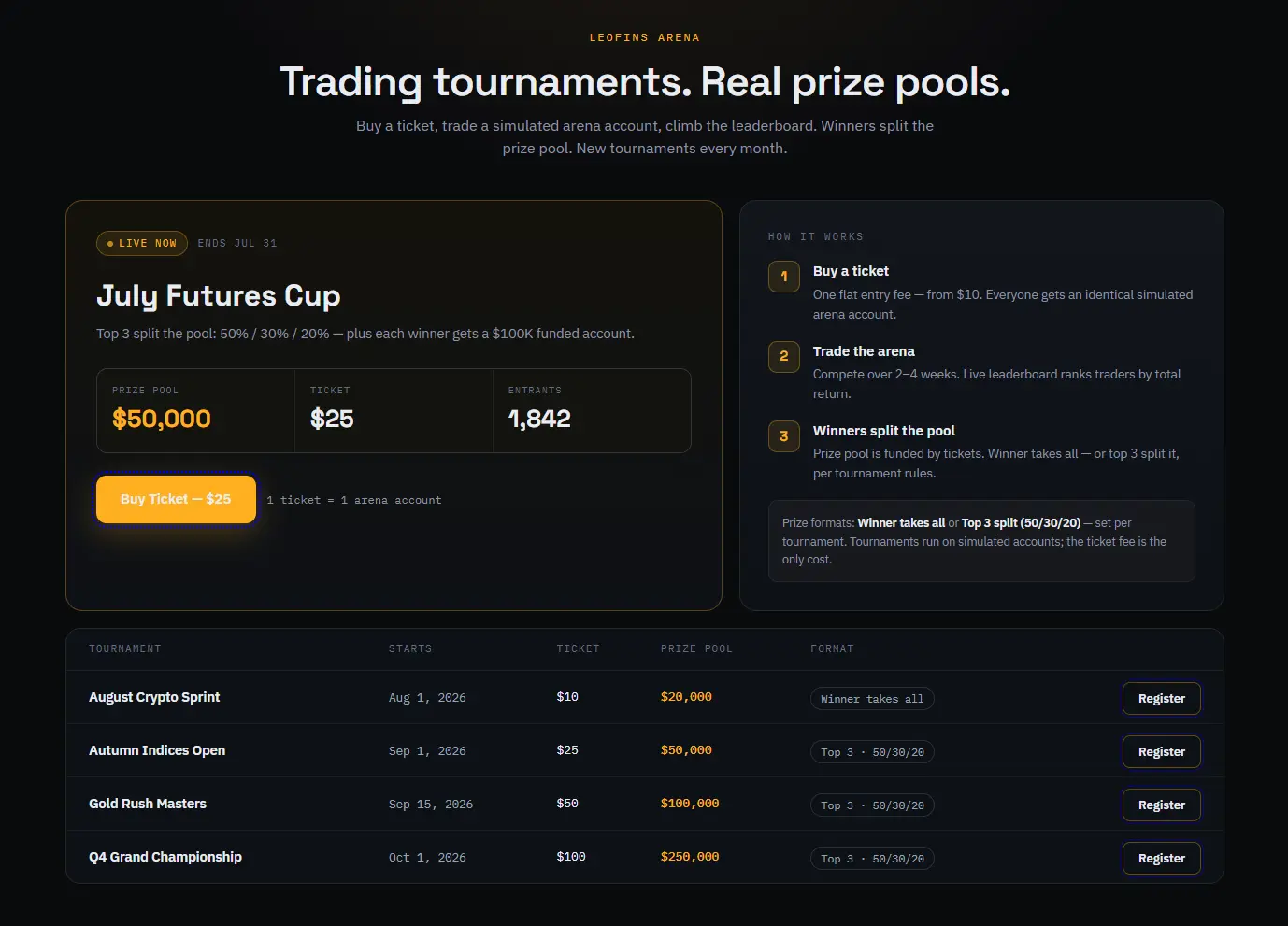 Leofins offers three challenge structures: Core 2-Step, Edge 1-Step, and Starter 3-Step. Its published fee policy states that the eligible challenge fee is refunded in full, but the payout at which it is returned depends on the selected program.
The official website, leofins.com, provides information about its challenge options, fees, and payout rules.
How Leofins handles challenge-fee refunds
- Core 2-Step: The challenge fee is returned with the first reward payout.
- Starter 3-Step: The challenge fee is returned with the first reward payout.
- Edge 1-Step: The challenge fee is returned with the second reward payout.
The refund is described as an amount paid in addition to the eligible reward, rather than a deduction from the trader’s profit share. That is an important distinction when estimating what a qualifying withdrawal could contain.
Leofins also publishes one-time challenge fees rather than recurring monthly subscriptions. Its published fee information states that challenge fees start at $59, although the actual price depends on the account and any applicable offer. Traders should confirm the current checkout amount rather than assume that the lowest advertised price applies to every account size.
What else should traders examine?
Refund timing is only one part of a challenge’s financial structure. Leofins publishes different evaluation paths with their own profit targets and risk limits. For example, its Core 2-Step program uses two evaluation phases, while Edge 1-Step has a single evaluation phase and a different loss-limit structure. Starter 3-Step spreads the evaluation across three phases.
These differences can influence how a trader approaches the evaluation and whether the program fits their strategy. A shorter evaluation path is not automatically easier, and a first-payout refund is not valuable if the trader chooses a challenge whose rules they cannot follow consistently.
Traders should also review payout eligibility, the firm’s consistency requirements, prohibited trading practices, and the current refund terms before paying. A refund is conditional on reaching the relevant milestone and complying with the program rules; it is not a reimbursement for an unsuccessful challenge.
Best suited to: Traders comparing one-, two-, and three-step evaluation structures who want a published full-fee refund tied to a defined payout milestone.
Potential drawback: Edge 1-Step returns the fee later than Core 2-Step and Starter 3-Step. The best option depends on the complete evaluation and payout rules, not the refund alone.
4. The5ers: Check the exact program and refund form
The5ers offers multiple trading programs, so it is important to identify the specific product before relying on a headline claim about refundable fees.
Published information for its High Stakes CFD program has described a refund arrangement that differs from a straightforward full cash refund on the first payout. The applicable terms have included a combination of cash and account credit, with eligibility conditions. The5ers also has separate futures programs, whose rules should not be assumed to match its CFD challenges.
This is a useful reminder that the word refund does not always mean the same thing. If a portion is paid as credit rather than cash, the trader may not be able to use that amount as freely as money returned to a payment method or included in a cash payout.
Before purchasing, check:
- Whether the selected account is a CFD or futures program.
- The percentage of the fee returned and whether the return is cash, credit, or a combination.
- Which payout milestone triggers the refund.
- Any minimum profit, holding-period, or account-compliance requirements.
- Whether promotional terms change eligibility.
Best suited to: Traders willing to read program-specific terms and compare the complete evaluation structure rather than choose on refund timing alone.
Potential drawback: Different refund forms and eligibility requirements can make the advertised benefit less straightforward to compare with a full fee returned in cash.
5. FundingPips: Eligibility is model-specific
FundingPips is another example of why traders should check the exact account model. Published refund information identifies the 2-Step Standard as an eligible model with the challenge fee returned alongside the fourth reward. Several other models, including 1-Step Flex, 2-Step Flex, 2-Step Pro, and Zero, have been listed as excluded from this arrangement.
Waiting until the fourth reward means the trader must consider more than the challenge fee. They should estimate how many qualifying payout cycles may be needed and ensure that the chosen model’s rules are compatible with their trading approach.
A fourth-payout refund is not necessarily a poor deal. A trader who already prefers the eligible program may consider it a useful additional benefit. However, someone comparing two otherwise similar programs should account for the delay rather than treating both as equally refundable.
Before buying, confirm the current terms for the selected model, including whether the fee is refundable, the exact reward milestone, and any requirements attached to payout requests.
Best suited to: Traders who specifically want the eligible 2-Step Standard structure and are comfortable with a later fee-refund milestone.
Potential drawback: The refund is not universal across models, and a trader who selects an excluded account should not expect the same benefit.
How to judge whether a refundable fee is genuinely valuable
The number of payout cycles required to recover a fee is a practical way to compare programs, but it is not the only factor. A refund that arrives early can still be poor value if the evaluation has unsuitable rules or the overall fee is much higher than alternatives.
Compare the full cost, not just the headline fee
Start with the amount you will actually pay after discounts and add-ons. Check whether platform, data, reset, or payment-processing costs apply, and whether those amounts are included in the refund. A policy returning the base challenge fee may not cover optional extras.
For example, suppose two challenges each cost $100. Firm A returns the fee with the first eligible payout, while Firm B returns it with the fourth. If both programs were otherwise identical and the trader qualified for all four payouts, Firm A would return the initial outlay sooner. In practice, however, the evaluation rules, payout schedules, and eligibility conditions are rarely identical, so this comparison should be treated as a simple illustration.
Read the payout conditions before the refund clause
A refund is only useful if the trader can qualify for it. Review the maximum daily loss, total drawdown, profit target, minimum trading days, consistency rules, and any restrictions on news trading, holding positions over weekends, or automated strategies.
Pay particular attention to the difference between passing an evaluation and becoming eligible to withdraw a reward. Some programs impose additional requirements after the evaluation stage. The fee-refund milestone may only be reached after those conditions are met.
Check what happens after a reset or breach
A reset may create a new fee amount or affect which payment qualifies for a refund. A rule breach can also end the account and remove eligibility for future payouts. Do not assume that the original fee remains refundable after a reset, account replacement, or other change.
Distinguish a refund from a payout
A reward is generally the trader’s eligible share of performance under the program’s terms. A challenge-fee refund is a separate return of the eligible purchase fee. Some firms add the refund to a payout; others may process it differently.
When calculating expected cash flow, keep the two amounts separate. Also account for payment-provider charges, currency conversion, and processing time where applicable.
Keep a copy of the terms in force when you purchase
Refund policies can change. Save the checkout details and the applicable terms for your account, including the program name, purchase date, price, add-ons, and stated refund milestone. If a policy is unclear, ask the firm for written clarification before making payment.
Frequently asked questions
Do all prop firms refund challenge fees?
No. Some firms refund eligible fees only for selected challenge models, while others offer no performance-based refund for particular products. Even when a firm has a refund policy, it may exclude add-ons, resets, platform charges, or discounted purchases.
Is the challenge fee refunded immediately after passing?
Usually not. Many programs link the refund to an approved reward or payout after the trader receives the relevant account. The precise milestone depends on the firm and challenge model.
Is a first-payout refund always better than a fourth-payout refund?
All else being equal, recovering the fee earlier is financially preferable. But other factors matter: the initial fee, drawdown limits, evaluation targets, payout requirements, and trading restrictions can outweigh the timing advantage.
Can a trader get a refund after failing a challenge?
A performance-based fee refund generally requires successful completion and eligibility for the specified payout. Failing an evaluation or breaching account rules normally does not qualify for this type of refund. A separate cooling-off policy may apply in limited circumstances, such as cancellation before trading begins, depending on the firm’s terms and applicable law.
Does a refundable fee mean the challenge is risk-free?
No. The trader pays the fee upfront and may lose it if the evaluation is unsuccessful or refund conditions are not met. The opportunity to recover a fee later does not remove the risk of losing the initial payment.
What should I check before buying a refundable challenge?
Confirm the exact account model, total checkout cost, refund amount, qualifying payout number, reset policy, and exclusions. Then review the risk limits and payout rules to decide whether the program is appropriate for your trading strategy.
Making the decision
A refundable challenge fee can improve the economics of a proprietary trading program, but only when the conditions are understood and the trader eventually qualifies. FTMO’s 2-Step Challenge links its refund to the first Reward withdrawal; FundedNext uses different milestones across its Stellar models; Leofins returns eligible fees on the first payout for Core 2-Step and Starter 3-Step and on the second for Edge 1-Step. The5ers and FundingPips illustrate why the precise program and refund form matter.
The most useful comparison is not simply which firm advertises a refund. It is which program offers rules you can realistically follow, a fee you can afford to lose, and a refund policy that is clear enough to plan around. Treat the refund as a possible recovery of your initial cost—not as guaranteed income or a reason to take greater trading risks.
Prices and conditions are current as of October 2026.
Risk disclaimer: Proprietary trading evaluations involve financial risk. Challenge fees may be lost if an evaluation is unsuccessful or program rules are breached. Simulated trading and funded-program results do not guarantee future performance or income. Review the current terms carefully and never spend money you cannot afford to lose.



Залишити відповідь